




















Employers are investing more in their group benefits, yet employees see less and less value in them. Canadian data from 2025 and 2026 shows where that value gets lost, through group benefits friction, and how to win it back.
In 2024, life and health insurers paid $53.3 billion in health benefits to some 27 million Canadians. Yet in 2026, barely 52% of employees say their program meets their needs very or extremely well. That is the lowest level in ten years.
Between what is funded and what is experienced, there is a gap. It has a name: friction. And the most costly kind is often the one no one measures.
of employees say their program meets their needs very or extremely well, a ten-year low
of employees rate their program excellent or good, compared with 82% of employers
of employers saw their health costs rise over the past year
Source: Benefits Canada Healthcare Survey, 2026 edition
Why don’t employers and employees see the same program?
The gap is clear: 82% of employers rate their program excellent or good, compared with 63% of employees. That is the lowest share in six years. At the same time, 69% of employers report rising costs. In other words, employers are paying more for a program that is viewed less favourably.
There is a reason for this gap. Employers assess their program based on its design: the coverage, the maximums, the premium. Employees judge it by using it: finding information, submitting a claim, waiting, sometimes facing a denial. Both are right, but they are not talking about the same thing.
First step: stop assessing the program only at renewal, based on cost and design. A simple test is enough to get started. Ask ten employees this question: “If you needed to see a psychologist tomorrow, what would you do?” Every hesitation reveals a friction point that the premium table will never show.
Can your employees find information when they need it?
In 2025, 53% of employees said they understood their program very well, and about one in ten said they did not understand it at all. Meanwhile, 70% of employers believed they explained coverage well. In 2018, the share of employees who understood their program well stood at 65%. We already discussed this understanding gap in an article published in March.
The cause is structural. Most information is delivered at onboarding, which is when employees need it least. The real need comes months later, often in difficult circumstances: in 2026, 36% of employees report high or extreme daily stress. No one rereads a 40-page booklet under those conditions.
Second step: communicate at the moment of need rather than at onboarding. Employees are not looking for a document. They are looking for a precise answer, such as: “Am I covered for physiotherapy, and how much do I have left?” That answer should be where they already look, online and on their phone, in plain language.
of employees understand their program very well
of employers believe they explain coverage well
Source: Benefits Canada Healthcare Survey, 2025 edition
More benefits, more points of entry?
What an employer can offer today goes far beyond group insurance: wellness products, prevention, financial health, supplementary or voluntary benefits. It is a real opportunity to meet needs that vary widely from one employee to the next.
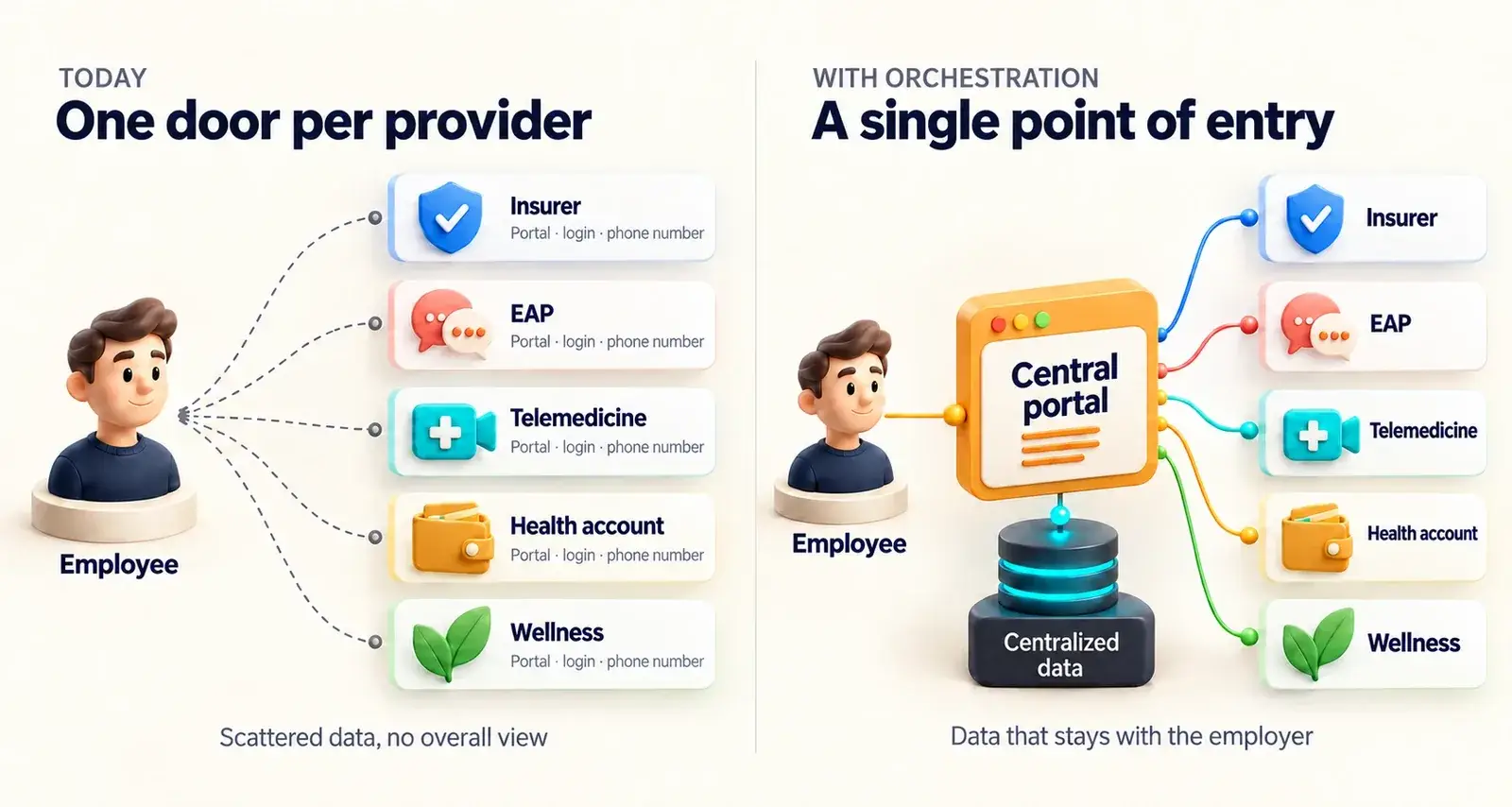
But every provider comes with its own portal, login and phone number. The employee assistance program (EAP) shows the consequences clearly. According to a Pollara survey conducted for Beneva, barely 3% of respondents would turn to an EAP first for a mental health issue, or about 10% of those who have access to one. The main barrier is not service quality: 35% of those who would not turn to it first don’t know about it or don’t know how to use it. TELUS Health also found that two in five workers don’t understand what an EAP is for.
of Canadians would turn to an EAP first for a mental health issue
don’t know about their EAP or don’t know how to use it
workers don’t understand what an EAP is for
Sources: Pollara for Beneva (2024), TELUS Health (2023)
Orchestration: a central point that follows the employee’s life
Orchestrating means bringing all of a program’s benefits together in one place, regardless of the provider. Employees can review their program there, and also respond to specific needs as they arise.
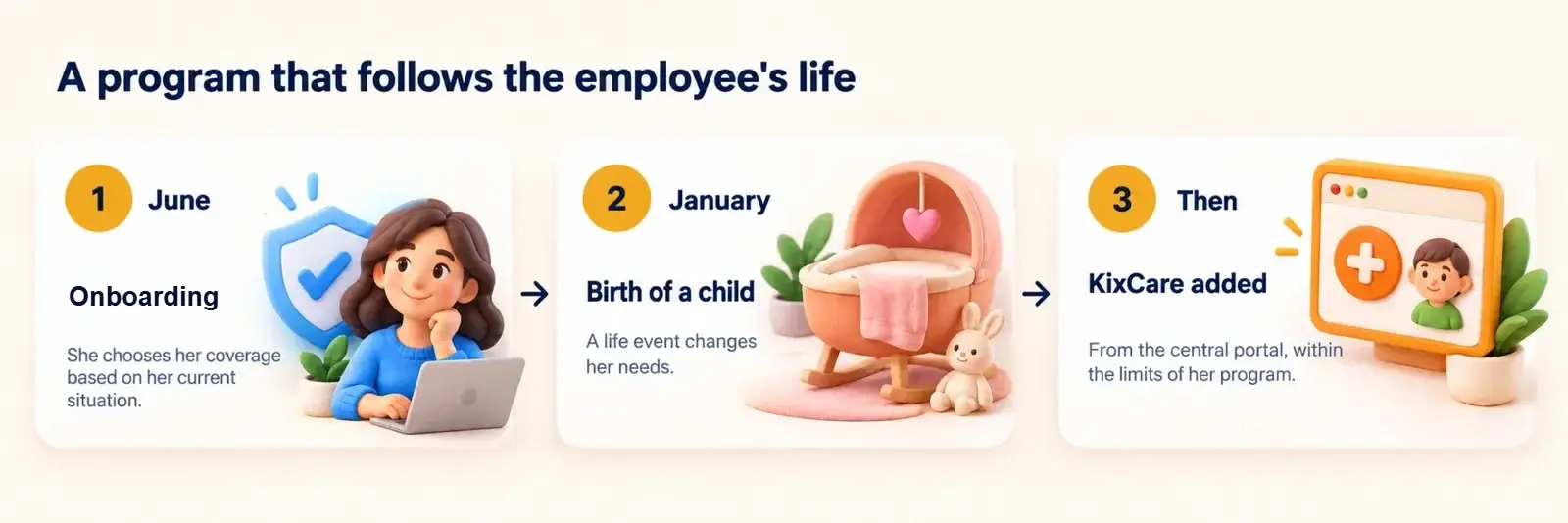
Because needs change during the year. Take an employee who onboards in June. She chooses her coverage based on her situation at the time. In January, she welcomes her first child. She would now like to add a pediatric telemedicine service such as KixCare, a voluntary benefit she had no reason to choose in June.
In a fragmented model, this change involves an email to HR, a form, a call to the provider, and then a wait. In an orchestrated model, she goes back to her central portal, adds the benefit within the limits set by her program, and the change is passed on to the right parties.
Third step: offer a single point of entry that brings together coverage, balances and supplementary benefits, and that lets employees adjust their program as life events occur.
Who controls your program’s data?
Fragmentation has a less visible but heavier consequence: loss of control over data. Two market realities explain it. First, when an employer changes insurers, it generally loses the accumulated history. Second, each provider keeps its own data, without integrating it into a shared ecosystem. As a result, most employers manage their program without an overall view of their employees’ real needs.
HR teams absorb the rest. According to the 2026 State of HR report from Folks, one of Segic’s partners, 70% of HR teams’ time in Canadian SMBs goes to administrative and operational tasks. We detail the costs of this manual work in our article on automation.
Fourth step: centralize program data, independently of each provider. The employer can then replace a provider without losing its history.
What role for the employer’s advisors?
Turning this insight into a program is no longer one player’s job. A whole ecosystem of advisors now surrounds the employer and shapes its HR and benefits strategy: brokers, actuaries and consultants, accounting and financial firms, and HR firms. Each one holds a piece of the puzzle, whether that’s plan design, the company’s financial health, talent management or knowledge of the market. A clear trend is emerging. Total compensation transformed how companies think about pay, and a total benefits approach now meets a pressing need for employers in the same way.
“Today, most advisors still work in silos. The broker focuses on group insurance, the accountant on costs and the HR firm on talent. Those who want to take a total benefits approach run into two obstacles: employers lose their data when they change insurers, and every provider remains isolated. Technology has become essential for enriching a program with wellness, prevention or financial health products. It centralizes data, orchestrates providers and lets you replace one without losing control. Advisors keep both hands on the wheel, and employers finally understand what’s happening on the ground.”
Danny Boulanger, President and CEO, Segic
For these partners, it’s a chance to broaden their role. They can move beyond a single area of expertise, like comparing premiums, analyzing costs or managing talent, and design a complete program together, built on data the employer keeps.
How do you audit group benefits friction?
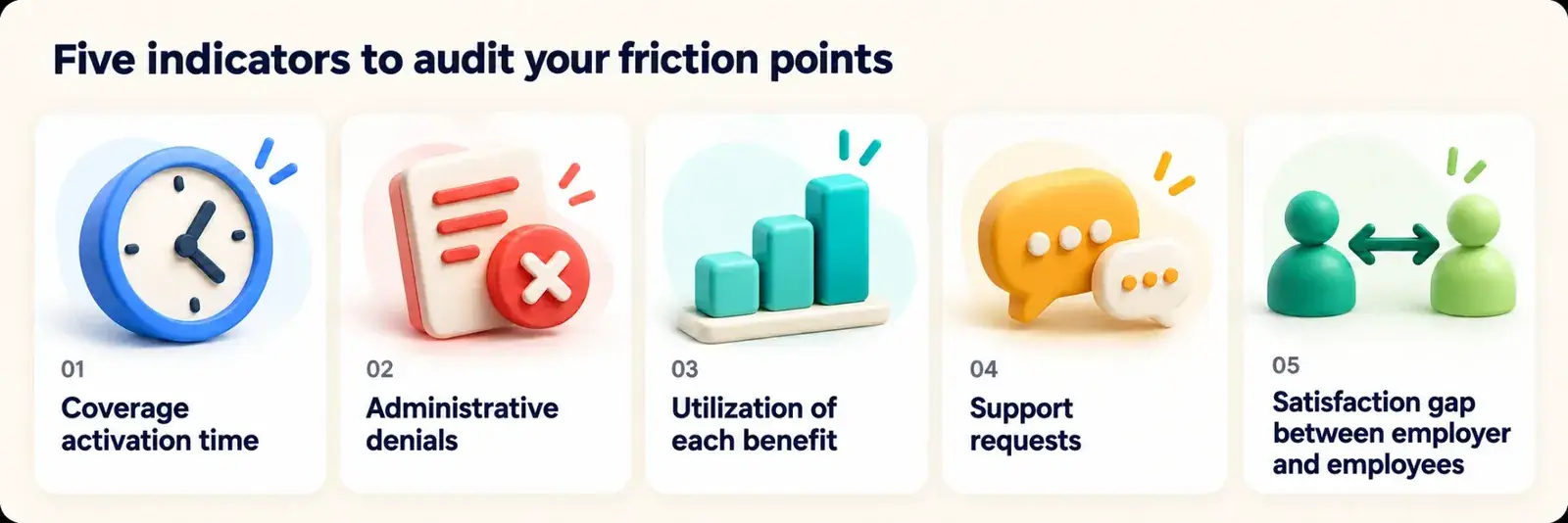
Auditing group benefits friction does not require new technology at the outset. Most of the data already exists with the insurer, the administrator or in the payroll system. What is mostly missing is someone to bring it together and read it as a whole. Five indicators are enough to get started:
- the time between hiring, or a life event, and the actual activation of coverage;
- the rate of claims denied or returned for administrative reasons rather than coverage reasons;
- the utilization rate of each benefit, compared with its cost;
- the volume and nature of support requests per employee;
- the gap between employer and employee satisfaction, measured through a short annual survey.
One last question completes the exercise: if you changed providers tomorrow, what data would you keep?
How Segic approaches this issue
At Segic, we approach group benefits as a whole to be orchestrated, not as a series of separate contracts. The platform centralizes program data, brings together benefits from multiple Canadian providers and gives employees a single point of entry to review their program and adjust it as their life changes. The broker designs the program, and the client remains theirs.

Benefits Marketplace
Insurance, wellness, prevention, financial health and voluntary benefits.
In conclusion: a program’s value is measured by what reaches the employee

A program’s generosity is not measured by what it covers on paper, but by what employees actually receive. Before your next renewal, three simple steps will help you move from insight to action:
- Ask your broker for a snapshot of utilization and administrative denials.
- Ask the psychologist question to about ten employees.
- List every provider and every point of entry in your program, then check who holds the data.
Orchestrate your benefits program
Talk to your broker, or discover how the Segic Platform brings your benefits, providers and data together in one place.
Frequently asked questions
- What are group benefits frictions?
They are all the obstacles between employees and the value of their benefits program. Information that’s hard to find, a complicated process, a delay before coverage takes effect and a claim denied for administrative reasons are all frictions. Each one lowers the value employees see in their program, even when the coverage itself is generous. - What is group benefits orchestration?
Orchestration brings benefits from multiple providers together in a single access point, with centralized data. Employees review and adjust their program in one place. Employers get a complete view of the program, and their advisors work from the same data. - Can an employee change their program during the year?
Yes, within the limits set by their program. A life event, such as the birth of a child or a marriage, generally allows employees to adjust their coverage. Depending on the program, some voluntary benefits can also be added during the year. - Why does centralized data matter to employers?
Data is often scattered across several providers, and changing insurers usually means losing the history. With centralized data, employers and their advisors understand what employees actually need. Employers can also change providers without starting from scratch. - What role do the employer’s advisors play in a total benefits approach?
Several advisors now help shape benefits strategy. The broker designs the group insurance program, while the actuary and the consultant assess its sustainability. The accounting or financial firm measures its costs, and the HR firm aligns it with talent management. An orchestration platform gives them common ground: centralized data, coordinated providers and a complete view of the program. Each advisor can then reach beyond their own specialty and help enrich the program with wellness, prevention or financial health products.
Sources
- CLHIA — Benefits paid in 2024 (2025 edition), 2025
- Benefits Canada — Benefits Canada Healthcare Survey 2026 (1,000 plan members, 500 plan sponsors), September 28, 2026
- Medavie Blue Cross — Benefits Canada Healthcare Survey 2025 summary, 2025
- Benefits Canada — Benefits Canada Healthcare Survey 2023, September 20, 2023
- Pollara for Beneva — Mental Health Services Coverage (3,207 respondents), February 2024
- TELUS Health — Mental Health Index, via Canadian HR Reporter, September 22, 2023
- Folks — 2026 State of HR, 2026